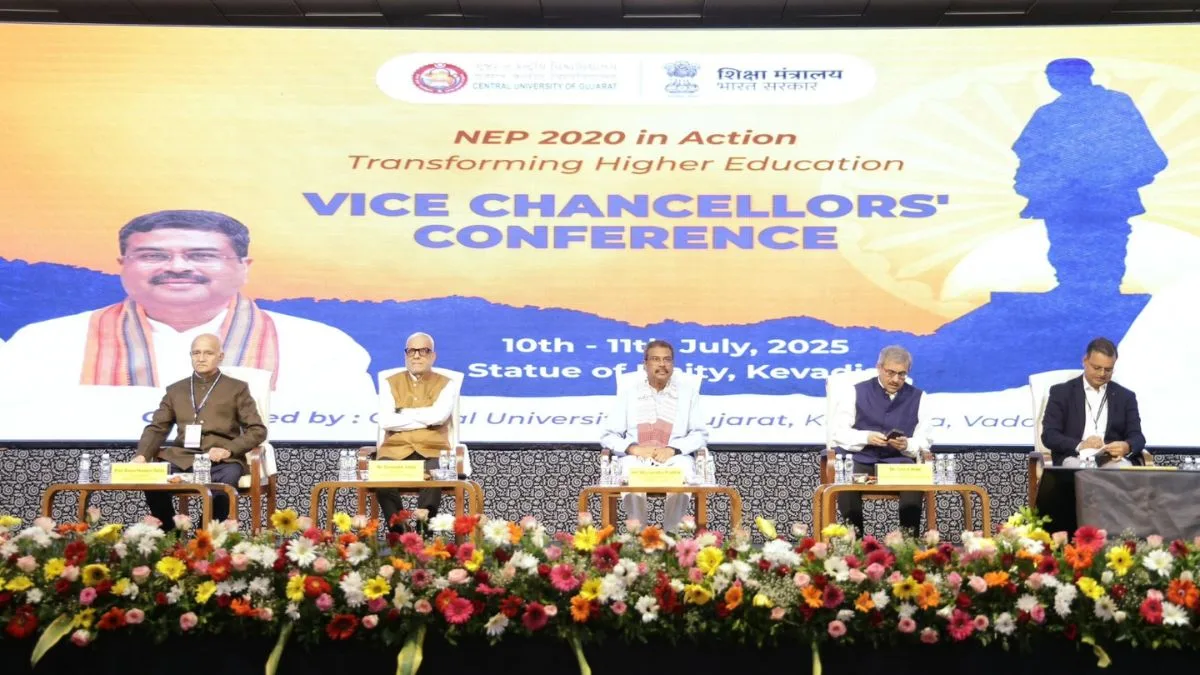
Union Minister of Education Dharmendra Pradhan has claimed that with over 1,200 universities and more than 46,000 colleges, India is one of the largest education systems globally. He also said that India’s higher education ecosystem has undergone a fundamental transformation, making it flexible, interdisciplinary, inclusive, and innovation-driven.
The union minister was addressing the two-day Vice-Chancellors’ Conference of Central Universities which commenced today at Kevadia, Gujarat. Over 50 Vice Chancellors of multiple higher education institutions are part of the conference whose main aim is to review, assess, and strategize the implementation of NEP 2020 since its inception. The conference is being organised by the Ministry of Education and the Central University of Gujarat.
Advertisement
Stating that in the last decade, India’s higher education ecosystem has undergone a major change, Pradhan said that total student enrolment has touched 4.46 crore, marking a 30 percent increase since 2014–15.
“Female enrolment has grown by 38 percent, and female GER now exceeded male Gross Enrolment Ratio (GDR), Ph.D. enrolment has almost doubled, and female Ph.D. scholars have grown by 13 percent. GER for Scheduled Tribes has increased by 10 percentage points, for SCs by over 8 points. This indicated the Government’s commitment to inclusive education and social justice,” he elaborated.
Speaking about the concept of Panch Sanklapa of NEP 2020 which would be the guideline for the VCs in their university gurukuls, the union minister asked them to devise changes to implement the objectives of the academic Triveni Sangamam with the objectives of celebrating the past (India’s richness), calibrating the present (India’s narrative correction), and creating the future (India’s role in the global order).
“This would ensure understanding the past, uncovering the present and unfolding the future in the contemporary framework,” he added. The concept of Panch Sanklapa is based on the themes including next-gen emerging education, multidisciplinary education, innovative education, holistic education and bharatiya Education.
Drawing attention towards the need to raise the GER in higher education to 50 percent by 2035, Pradhan said it can be done by taking definitive actions in critical areas such as redesigning curricula, building digital systems, training faculty and promoting multidisciplinary approaches.
“For attaining this objective, it was imperative for the Vice Chancellors to act as catalysts in shaping the mindset and aspirations of students. The universities must follow “Students-First” approach, students should be the centre of all our reforms as they constituted the core of our national strength for the future,” he said adding that the institutions should be built for the future where skilled and future ready to promote ready work force and students were empowered to be job creators, social entrepreneurs and ethical innovators.
He also asked the participants to prepare a strategy paper for a full implementation of NEP 2020 in every university. “It should include: multidisciplinary integration of subjects, mainstreaming Indian Knowledge System (IKS), devising strategies for tech driven education to promote skilling and up-skilling, campus initiatives focusing on innovation and integration of technology with traditional values and conferences like VC’s conference should be organised in the individual university campuses,” he added.
Dr. Hashmukh Adhia, Chancellor, Central University of Gujarat, in his address outlined comprehensively the “Six Principles” of karmayoga and emphasised the role and importance of Indian Knowledge Systems in the lives of individuals, society and the nation. He called upon the participants to practice the principles in achieving their goals and objectives in life.
The inaugural day will feature discussions on six thematic sessions centered on strengthening the pillars of India’s higher education ecosystem, academic mobility, aligning teaching & learning with the future of work, skill alignment, digital education, university governance systems, equity in higher education, and integration of Indian knowledge systems.